




















|
Getting your Trinity Audio player ready...
|
By: Fern Sidman
A New York state judge’s decision to overturn disciplinary sanctions imposed on 22 anti-Israel protesters who stormed and occupied Columbia University’s Hamilton Hall has ignited a new chapter in the fraught national debate over campus unrest, antisemitism, and the limits of institutional authority. The ruling, handed down last Friday by Judge Gerald Lebovits, has raised profound concerns that universities may be stripped of the practical ability to discipline students who commit severe misconduct while cloaking their actions in the language of political activism.
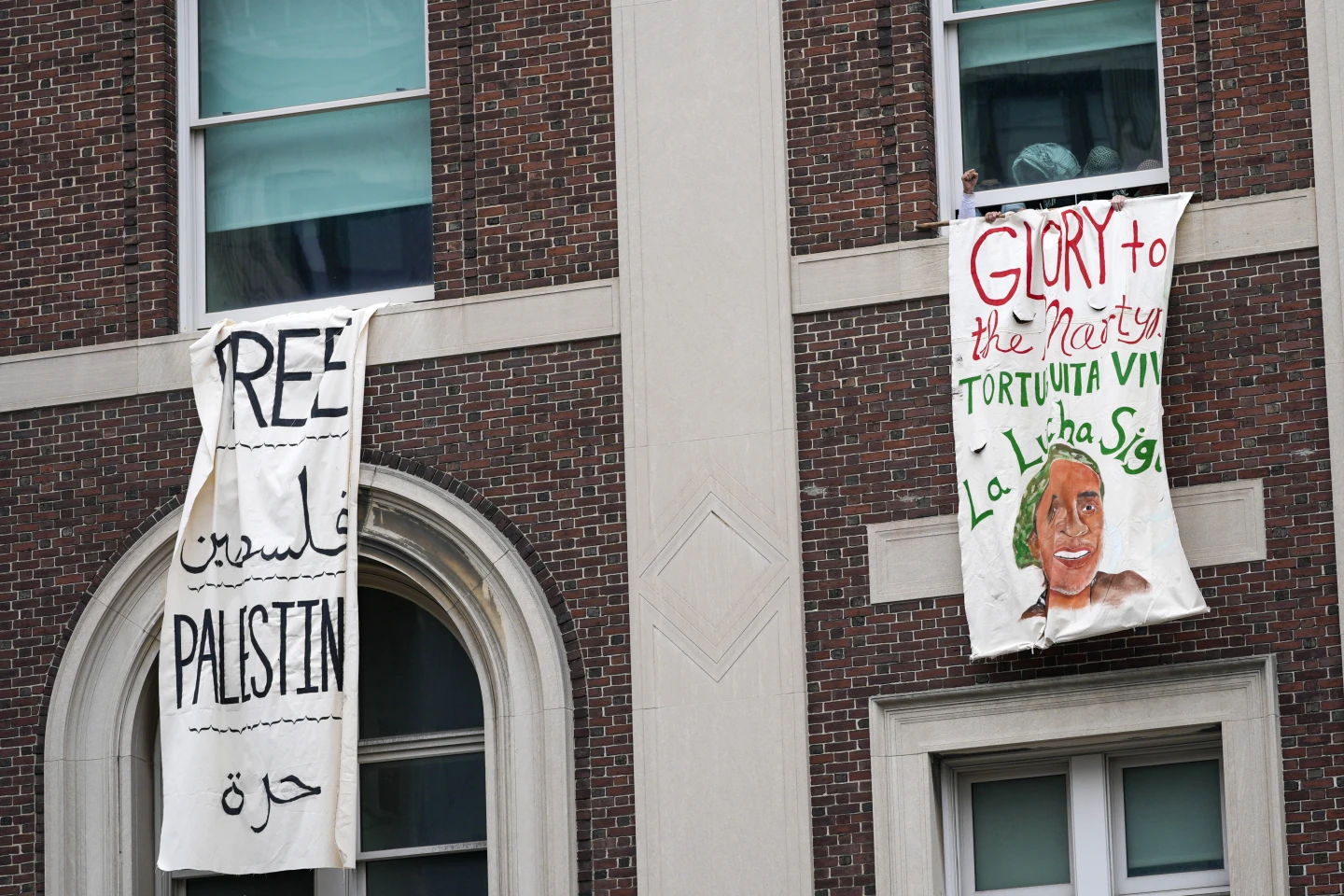
As reported on Wednesday by The Algemeiner, the 22 current and former students — all of whom challenged their sanctions anonymously — may now avoid consequences for their participation in the April 2024 occupation of Hamilton Hall. The protest, staged amid the Israel-Hamas war, was marked not only by the unlawful seizure of university property but by the confinement of janitorial staff and the destruction of campus facilities. Yet Judge Lebovits ruled that Columbia’s disciplinary actions were “arbitrary and capricious,” effectively vacating the penalties that the institution had imposed.
In his opinion, Lebovits argued that Columbia failed to establish individual culpability beyond the fact of arrest. According to the information provided in The Algemeiner report, he wrote that the “sole evidence” presented in the disciplinary proceedings was a report indicating that the petitioners had been arrested inside Hamilton Hall. The court found that the university had not produced evidence detailing specific acts carried out by particular students, distinguishing between the conduct of the group and the actions of each individual.
In a striking passage cited by The Algemeiner, Lebovits pointed to the protesters’ use of masks and keffiyeh scarves as complicating factors, suggesting that their concealment of identity hampered the university’s ability to definitively place them at the scene — despite their having been arrested there by the New York City Police Department. The implication, critics argue, is that anonymity during the commission of a campus occupation could insulate participants from institutional discipline.
Lebovits went further still, characterizing the occupation of Hamilton Hall as part of a “decades-long tradition” at Columbia. While acknowledging that some observers might interpret the demonstrators’ rhetoric as reflective of “an ugly hatred against Jews,” he emphasized that the court’s task was not to adjudicate moral or political questions but to assess the procedural propriety of the university’s actions.
The decision does not take effect immediately. In a statement shared with The Algemeiner, Columbia University noted that the order will not be implemented for at least 30 days, during which time the institution may seek a stay or pursue an appeal. “No student who was disciplined for the occupation of Hamilton Hall can return to campus at this time,” a university spokesperson said, adding that Columbia is considering “all of its options.”
The underlying events unfolded in April 2024 when anti-Israel activists seized Hamilton Hall in one of the most dramatic campus protests of the Gaza war era. Then-university president Minouche Shafik, after initial hesitation, ultimately summoned the NYPD to restore order. When officers entered the building, they discovered an unsettling array of materials: gas masks, helmets, goggles, ear plugs, tape, hammers, knives, ropes, and even a book labeled “TERRORISM [sic].” Among the signage recovered were placards bearing slogans such as “death to America” and “death to Israel.”
Simultaneously, a group known as Columbia University Apartheid Divest (CUAD) declared parts of the campus a “liberated zone,” lit flares, and chanted pro-Hamas slogans. Some demonstrators openly aligned themselves with Hamas, with one protester filmed shouting, “Yes, we’re all Hamas, pig!” Others were captured chanting “Long live Hamas!” and praising the al-Qassam Brigades, the terrorist organization’s armed wing.
When police moved to dismantle the encampment, hundreds of students reportedly surrounded officers in an attempt to obstruct the restoration of order. The spectacle, which unfolded amid mounting national scrutiny of campus antisemitism, became emblematic of the broader turmoil gripping elite universities after Hamas’s October 7, 2023 massacre in southern Israel.
Columbia has been among the most visible flashpoints in this saga. Incidents on campus have included a student declaring that Zionist Jews deserved to be murdered and administrative officials participating in a group chat that circulated antisemitic tropes portraying Jews as privileged and exploitative. These episodes prompted widespread condemnation and congressional scrutiny.
In July, interim president Claire Shipman announced a series of reforms. As The Algemeiner reported at the time, Columbia pledged to hire new coordinators to oversee antisemitism complaints, implement deeper educational programming on antisemitism, and adopt the International Holocaust Remembrance Alliance (IHRA) definition of antisemitism — a widely endorsed framework designed to clarify the boundaries between legitimate criticism of Israel and antisemitic rhetoric.
Shipman also vowed that the university would not “recognize or meet with” CUAD, signaling an effort to marginalize a group that had repeatedly disrupted academic life. New partnerships were forged with the Anti-Defamation League and other Jewish organizations, steps that many observers interpreted as an institutional acknowledgment of the severity of the crisis.
Yet critics contend that these reforms have been unevenly applied. The Algemeiner report highlighted the continued employment of Joseph Massad, a tenured professor who publicly characterized Hamas’s October 7 attack as “awesome.” Despite the brutality of that massacre — which involved the murder of civilians, sexual assault, and the kidnapping of elderly and children — Massad remains on faculty and continues to teach courses on the Israeli-Palestinian conflict.
In January, Asaf Romirowsky, executive director of Scholars for Peace in the Middle East, told The Algemeiner that Massad’s retention reflects a broader reluctance to enact substantive reform. “Joseph Massad is a notorious tenured antisemite who has spent his career at Columbia bashing Israel and Zionism,” Romirowsky said. He argued that allowing Massad to continue teaching perpetuates what he described as an intellectual environment hostile to Jewish students.
The December report issued by Columbia’s own antisemitism task force found that few faculty members hold moderate views on the Israeli-Palestinian conflict, reinforcing concerns that the campus climate remains deeply polarized. Romirowsky urged the university to act decisively on the task force’s findings by removing “tenured radicals” who, in his view, have hijacked the institution’s academic mission.
Against this backdrop, Judge Lebovits’s ruling has intensified anxieties about the practical authority of universities to maintain order. If participation in an illegal occupation can be shielded by procedural arguments about individual identification, critics warn, institutions may find themselves unable to impose meaningful consequences for coordinated acts of disruption.
Supporters of the decision counter that due process must prevail, even in politically charged contexts. They argue that universities, like courts, must demonstrate individualized evidence before imposing sanctions. Yet The Algemeiner’s coverage underscores the tension between procedural rigor and institutional governance — particularly when the underlying conduct involves not only trespass but intimidation and the propagation of extremist rhetoric.
For Columbia, the immediate question is legal strategy. An appeal could seek to clarify the evidentiary standards required for campus discipline in cases of collective misconduct. More broadly, the case may set a precedent influencing how universities nationwide respond to protest movements that test the boundaries of free expression and unlawful action.
As The Algemeiner reported, the stakes extend beyond a single campus. The Hamilton Hall occupation became a symbol of a broader reckoning over antisemitism, academic freedom, and the responsibilities of higher education institutions in moments of political upheaval. Whether Columbia can reconcile its commitment to due process with the imperative to safeguard students and uphold institutional integrity remains an open question.
For now, the court’s ruling has injected uncertainty into an already volatile landscape. As universities grapple with the legacy of a turbulent year, the outcome of Columbia’s next legal steps may help determine whether campus administrations retain the authority to discipline severe misconduct — or whether that authority will be curtailed in the name of procedural exactitude.



1 Comment
Jen
April 9, 2026Scumbag judge