



















|
Getting your Trinity Audio player ready...
|
(Epoch Times) The U.S. military on March 22 confirmed that more damage was done to Iranian military infrastructure in the ongoing operation as the Trump administration and Iranian officials traded threats over access to the Strait of Hormuz.
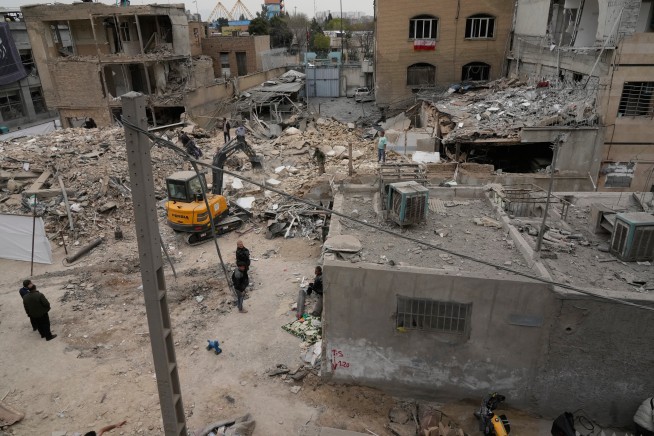
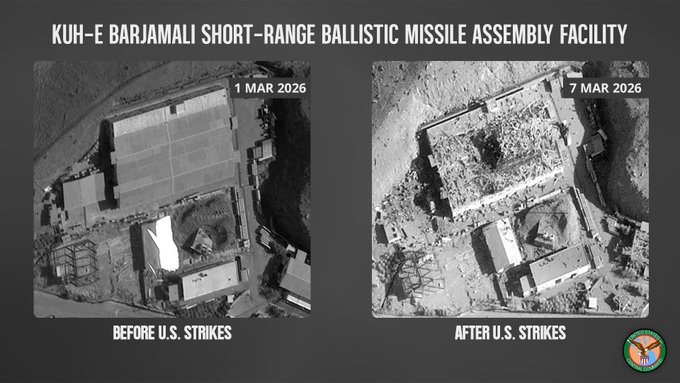
“The Iranian regime built close, short, and medium-range ballistic missiles at the Kuh-E Barjamali Ballistic Missile Assembly Facility,” the U.S. Central Command (CENTCOM) said in a post on X, showing before-and-after pictures of the site.
U.S. forces continue to eliminate the Iranian regime’s one-way attack drone capabilities, which they’ve used to indiscriminately target civilians throughout the region. pic.twitter.com/AbdLMmtoei
— U.S. Central Command (@CENTCOM) March 22, 2026
“The first photo shows what the location looked like on March 1, 2026,” the command, which operates in the Middle East, said in the post. “The photo dated March 7, 2026 is what the buildings look like now. Out of commission.”
The Iranian regime built close, short, and medium-range ballistic missiles at the Kuh-E Barjamali Ballistic Missile Assembly Facility. The first photo shows what the location looked like on March 1, 2026. The photo dated March 7, 2026 is what the buildings look like now. Out of… pic.twitter.com/uS5IKMNbWq
— U.S. Central Command (@CENTCOM) March 22, 2026
Also on March 22, CENTCOM confirmed that more than 8,000 U.S. military flights have been flown in the campaign that started in late February, and it disputed claims by Iranian state-run media outlets that the Iranian military shot down an F-15 fighter jet.
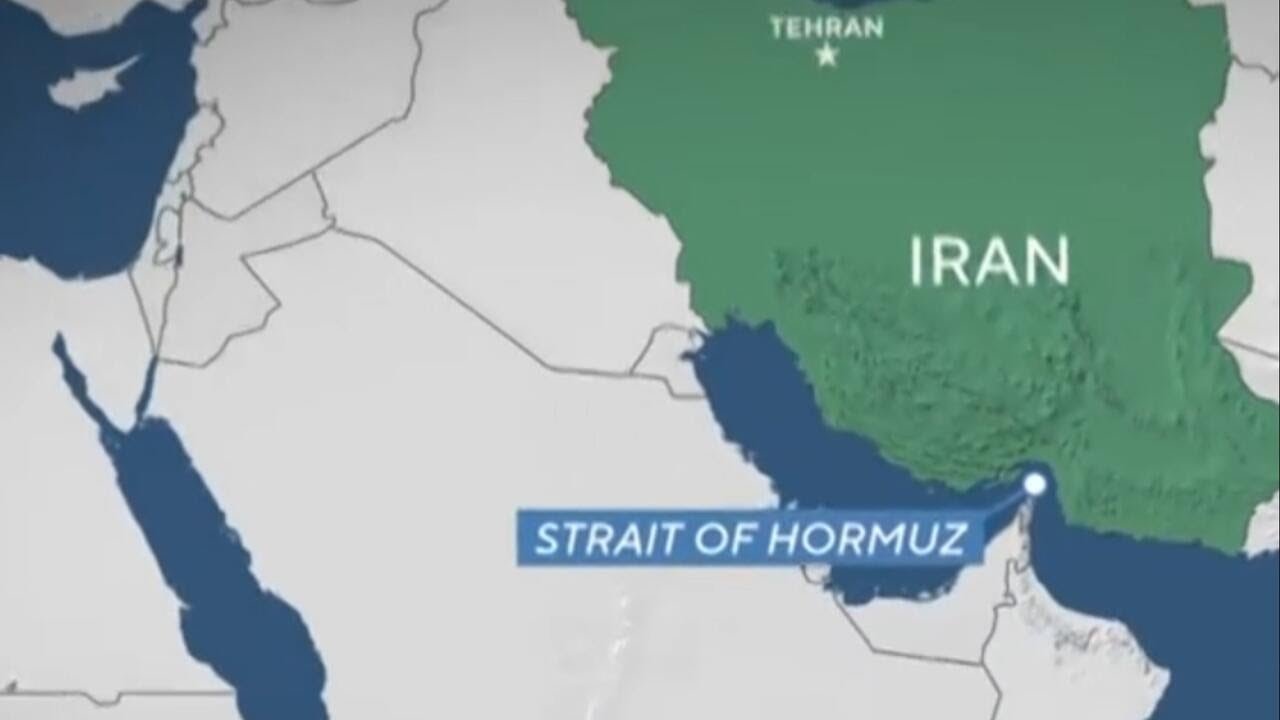
The updates come as officials of the Iranian regime threatened to shut down the Strait of Hormuz, a critical waterway through which about 20 percent of the world’s oil passes. Traffic through the strait has come to a near standstill since the start of the war.
Iran said the strait would be “completely closed” if the United States follows through on U.S. President Donald Trump’s warning that it will begin knocking out its power plants if Iran doesn’t unconditionally open the strait. Trump set a 48-hour deadline late on March 21.
The developments signaled that the war, which the United States and Israel launched on Feb. 28, was escalating in a new direction, although Trump also said that he was considering “winding down” operations.
Trump wrote in a post on social media that if the Iranian regime doesn’t fully open, without threat, the Strait of Hormuz, the U.S. military will move to destroy its “various POWER PLANTS, STARTING WITH THE BIGGEST ONE FIRST.”
But Iranian parliament speaker Mohammad Bagher Qalibaf said in a post on X that if Iran’s power plants and infrastructure were targeted, then vital infrastructure across the region would be considered legitimate targets and “irreversibly destroyed.”
In a Fox News interview on March 22, U.S. Ambassador to the United Nations Mike Waltz said that Trump’s promise to start knocking out the country’s power plants is a legitimate warning, saying that the Iranian Revolutionary Guard Corps controls much of the country’s infrastructure and is using it to fuel its war effort.
“There are gas-fired thermal power plants and other type of plants,” Waltz said.
“The president is not messing around.”
Waltz also said Iran was moving toward producing longer-range missiles and was working on developing an intercontinental ballistic missile that would be able to strike targets thousands of miles away.
“They have developed a reentry capability with these intermediate-range missiles,” he said. “And all you have to do is marry up the two with a nuclear warhead. … President Trump isn’t waiting until that happens and then trying to respond to it.”
In recent days, more than a dozen countries around the world, including European and Asian nations, released a joint statement calling for the Strait of Hormuz to be reopened and condemning Iranian attacks on civilian vessels. So far, none of the countries has publicly responded to Trump’s direct calls for other countries to get involved in securing the waterway.