






















|
Getting your Trinity Audio player ready...
|
By: Fern Sidman
A storm of controversy has engulfed public discourse following incendiary remarks by Palestinian-American author Susan Abulhawa, whose sweeping denunciation of Jewish Americans has drawn sharp rebuke from political leaders, commentators, and advocacy organizations alike. The episode, which unfolded against the backdrop of an already fraught political moment in New York City, has reignited urgent concerns about the normalization of antisemitic rhetoric in mainstream conversation—a trend extensively documented in a report on Thursday in The Times of Israel.
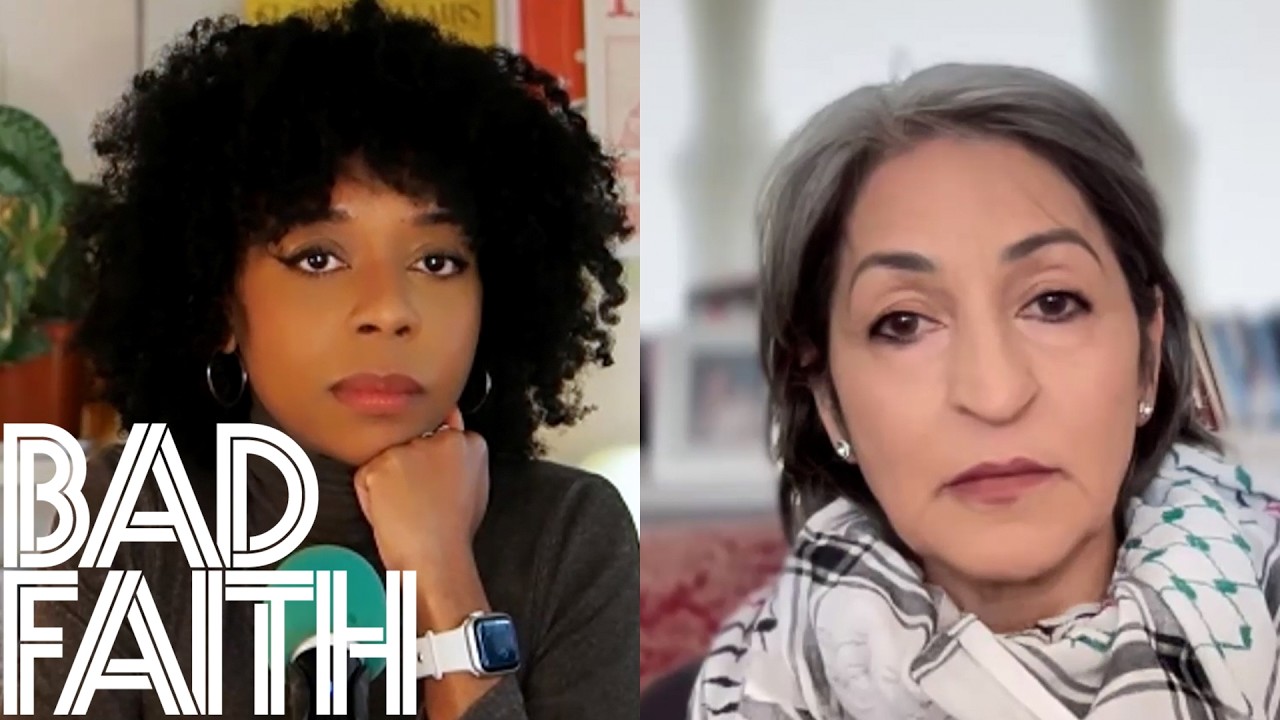
At the center of the controversy is a series of comments made by Abulhawa during an interview with political commentator Briahna Joy Gray. The interview, provocatively titled “Zohran throws Palestinians under the bus after Zionist hitjob,” was ostensibly focused on New York City Mayor Zohran Mamdani and the political fallout surrounding his wife, illustrator Rama Duwaji. Yet what began as a critique of political positioning quickly escalated into a broad and deeply troubling indictment of Jewish Americans as a whole.
The interview with the Jew hating freak Susan Abulhawa above
The origins of the dispute lie in revelations that Duwaji had illustrated a book authored by Abulhawa, a figure long associated with overtly antisemitic statements. As The Times of Israel has reported, the connection between Duwaji and Abulhawa prompted scrutiny, particularly given the latter’s history of inflammatory rhetoric.
Mayor Mamdani sought to distance his wife from the author, emphasizing that the professional relationship had been mediated through a third party and that the two had never met. He went further, publicly condemning Abulhawa’s past remarks as “reprehensible,” an unusually direct rebuke that underscored the seriousness of the issue.
Yet Abulhawa responded not with contrition, but with escalation. In her interview, she accused Mamdani of opportunism, suggesting that he had exploited Palestinian suffering for political gain before retreating under pressure. While such criticism, however contentious, falls within the bounds of political discourse, what followed did not.
Abulhawa’s subsequent remarks, as detailed in The Times of Israel report, ventured into territory that is unequivocally antisemitic. She asserted that Jewish Americans constitute “the most privileged demographic” in the United States and went on to attribute perceived global grievances to their collective support for Israel.Most alarmingly, she characterized Jewish Americans in dehumanizing terms, declaring that she lacked “a vocabulary that’s terrible enough” to describe them and concluded with the chilling assertion that “no terrible words should be spared for these monsters.”
Such language is not merely offensive but dangerous. It echoes historical patterns of collective blame and dehumanization that have, across centuries, served as precursors to discrimination, persecution, and violence against Jewish communities.
The controversy unfolds at a time when antisemitism is experiencing a documented resurgence, both in the United States and globally. As The Times of Israel has consistently reported, incidents of anti-Jewish hostility have surged in recent years, fueled in part by polarizing debates surrounding Israel and the broader Middle East.
While criticism of any government’s policies is a legitimate and necessary component of democratic discourse, the conflation of political critique with attacks on an entire people represents a fundamental breach of ethical and intellectual standards. Abulhawa’s remarks exemplify this conflation, attributing collective guilt to Jewish Americans based on perceived political affiliations.
This rhetorical shift—from critique to condemnation, from policy to identity—is precisely what distinguishes legitimate debate from prejudice. By framing Jewish Americans as a monolithic entity deserving of vilification, Abulhawa’s statements cross a line that should remain inviolable.
The response to Abulhawa’s comments has been swift and unequivocal. Across the political spectrum, voices have emerged to denounce the remarks as not only another egregious manifestation of Jew hatred but remarks that are profoundly irresponsible.
Advocacy organizations have warned that such rhetoric contributes to an environment in which antisemitism can flourish, normalizing language that dehumanizes and isolates Jewish individuals. Scholars and commentators have similarly emphasized the historical resonance of Abulhawa’s words, noting their unsettling parallels to propaganda that has historically targeted Jewish communities.
In its coverage, The Times of Israel has highlighted the growing concern that extreme rhetoric, once confined to the fringes, is increasingly entering mainstream discourse. This trend, they note, poses a significant challenge to efforts aimed at fostering tolerance and mutual respect.
The controversy also raises important questions about the responsibilities of public figures, particularly those with substantial platforms and influence. As an author with a significant following, Abulhawa’s words carry weight, shaping perceptions and potentially influencing public attitudes.
With such influence comes a corresponding obligation to engage in discourse that is both rigorous and responsible. The deliberate use of dehumanizing language, critics argue, represents a failure to meet this obligation.
Mayor Mamdani’s response, while measured, reflects an awareness of this responsibility. By condemning Abulhawa’s remarks, he sought to draw a clear distinction between legitimate political disagreement and rhetoric that targets individuals based on their identity.
Yet the episode also underscores the challenges faced by public figures in navigating complex and often volatile issues. The intersection of personal associations, political pressures, and broader societal tensions creates a landscape in which missteps can have far-reaching consequences.
For many observers, Abulhawa’s comments are not an isolated incident but part of a broader pattern. As documented in previous reporting by The Times of Israel, the author has a history of statements that are vehemently antisemitic, often framed within a broader critique of Israel.
Moreover, it reinforces a narrative in which complex political issues are reduced to simplistic and divisive binaries, hindering efforts to achieve meaningful dialogue and resolution.
Perhaps the most troubling aspect of the controversy is the language of dehumanization employed by Abulhawa. The characterization of any group as “monsters” is not merely rhetorical excess; it is a form of language that strips individuals of their humanity, rendering them unworthy of empathy or consideration.
History offers numerous examples of the consequences of such language. From the propaganda of totalitarian regimes to the rhetoric that has preceded acts of mass violence, the dehumanization of Jews has consistently served as a precursor to harm.
In this context, Abulhawa’s remarks take on a significance that extends beyond the immediate controversy. They serve as a stark reminder of the power of words—and the responsibility that accompanies their use.
The episode has prompted renewed calls for vigilance in addressing the resurgence of antisemitism and other forms of prejudice. As The Times of Israel has emphasized in its coverage, combating such Jew hating rhetoric requires not only condemnation but also a sustained commitment to education, dialogue, and accountability.
This includes a recognition of the distinction between legitimate political critique and language that targets Jews based on their identity. It also requires a willingness to confront uncomfortable truths about the ways in which antisemitism can manifest, even within movements that purportedly seek to promote justice and equality.
In the final analysis, the controversy surrounding Susan Abulhawa’s remarks represents more than a momentary scandal. It is a reflection of deeper tensions within contemporary discourse, where the boundaries between critique and condemnation are increasingly blurred.
By crossing those boundaries, Abulhawa has not only provoked outrage but also highlighted the urgent need for a renewed commitment to principles of respect and responsibility. As the reporting of The Times of Israel makes clear, the stakes are high—not only for American Jews but for the broader fabric of society.
In an era marked by polarization and division, the imperative to uphold these principles has never been more critical. Words have power, and when wielded recklessly, they can inflict harm that extends far beyond the moment in which they are spoken.