














|
Getting your Trinity Audio player ready...
|
By: Fern Sidman
In the vast and often bewildering landscape of Middle Eastern geopolitics, there are moments when a single, clarifying framework cuts through the noise and reveals the underlying architecture of conflict. One such framework—rarely articulated with sufficient clarity in mainstream discourse—is what may be described as the “domino effect” of Iran’s regional influence. This is not a speculative theory or an abstract geopolitical model. It is a concrete, observable reality rooted in decades of financial flows, military patronage, and ideological alignment.
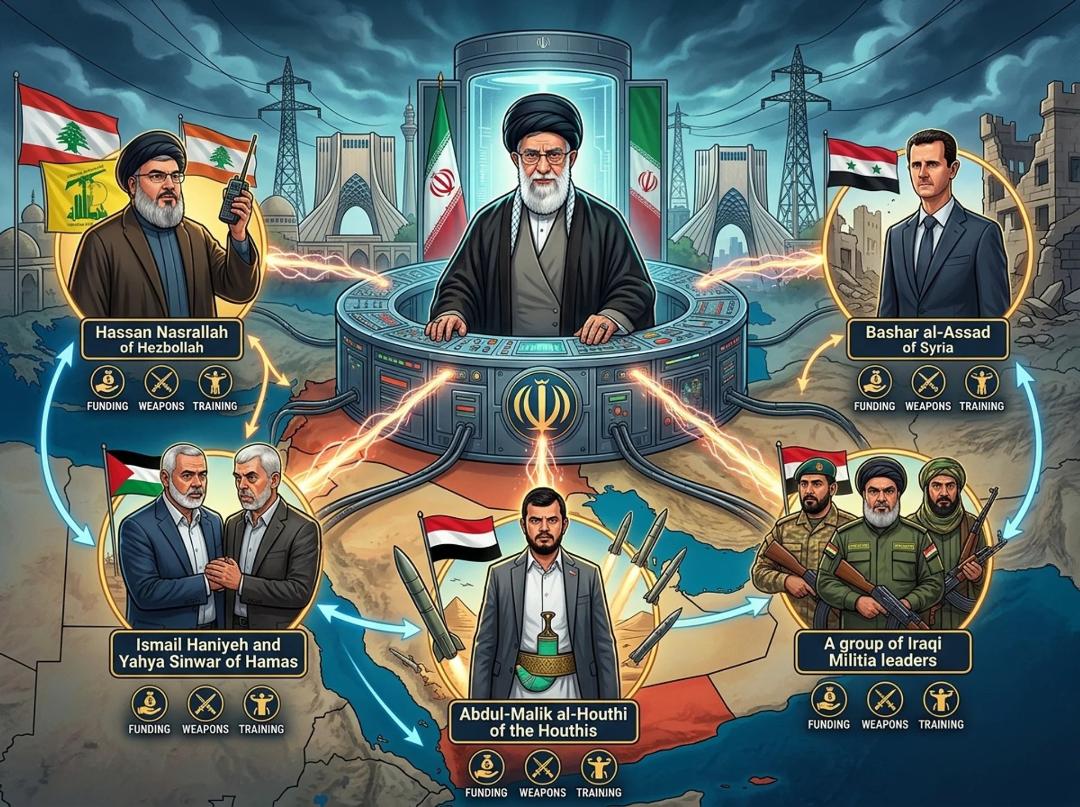
At its core lies a simple but profound proposition: the Islamic Republic of Iran is not merely a participant in regional conflicts—it is the central engine that sustains a sprawling network of armed groups across the Middle East. Remove that engine, and the entire structure begins to falter, if not collapse outright. The evidence is substantial, the implications are far-reaching, and the stakes could not be higher.
The Central Node: Iran as a Funding Machine
Since the 1979 revolution, Iran’s ruling regime has positioned itself as the principal sponsor of militant movements throughout the region. This sponsorship is not incidental or sporadic; it is systematic, sustained, and deeply embedded in the regime’s strategic doctrine.
Iran’s approach combines financial support, weapons transfers, training, and operational coordination. At the heart of this system is the Islamic Revolutionary Guard Corps, which functions as both a military force and a transnational organizer of proxy networks.
The result is a highly integrated web of influence, in which multiple groups—operating in different countries and under different banners—are nonetheless connected by a common source of funding and direction.
This is the “source” referred to in the domino framework. And it is this source that, if removed, would trigger cascading consequences across the region.
Domino One: Hezbollah in Lebanon
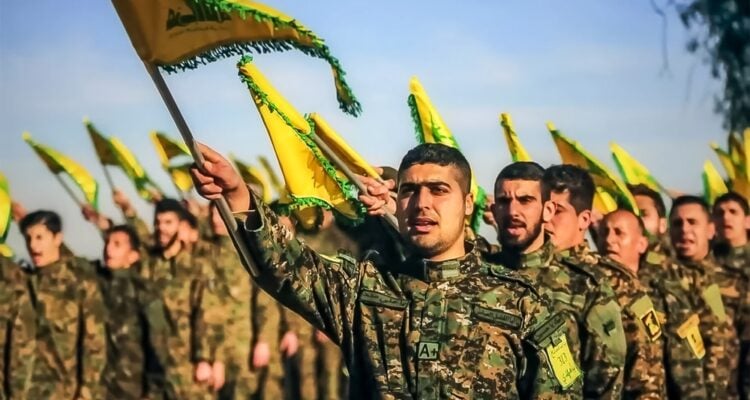
Hezbollah represents perhaps the most fully developed example of Iran’s proxy model. Established in the early 1980s with direct Iranian support, the organization has evolved into a formidable military and political force within Lebanon.
Crucially, Hezbollah’s operational capacity is overwhelmingly dependent on Iranian funding. Estimates place this support at between $700 million and over $1 billion annually. This funding underwrites everything from weapons procurement to salaries, social services, and media operations.
To describe this as merely “support” would be an understatement. It constitutes the backbone of Hezbollah’s existence as a military entity. Without it, the organization would face an immediate and severe contraction of its capabilities.
The conclusion is inescapable: without Iran, Hezbollah as it currently exists would not be sustainable.
Domino Two: Hamas in Gaza
The case of Hamas further underscores the centrality of Iranian financing. While Hamas has historically drawn support from a variety of sources, recent data indicates that approximately 93 percent of its funding originates from Iran.
This translates into an estimated $100 million to $350 million annually, delivered in various forms, including direct cash transfers and logistical support.
Such a high degree of dependence leaves little room for ambiguity. Hamas’s ability to conduct military operations, maintain infrastructure, and exert control in Gaza is intrinsically tied to this financial lifeline.
Remove that lifeline, and the organization’s operational capacity would be drastically curtailed. The notion that Hamas could continue to function at its current level without Iranian support is not supported by the available evidence.
Domino Three: The Houthis in Yemen
In Yemen, the Houthi movement provides another illustration of Iran’s reach. While the group has local roots and grievances, its transformation into a significant regional actor has been facilitated by Iranian assistance.
This assistance includes annual funding estimated at between $100 million and $200 million, as well as weapons shipments, training programs, and the presence of Iranian military advisors.
The impact of this support is evident in the Houthis’ increasing sophistication, particularly in their use of missiles and drones.
Without Iran’s backing, the Houthis would likely revert to a more localized, less technologically advanced force. Their capacity to project power beyond Yemen’s borders would be significantly diminished.
Domino Four: Iraqi Militias
Iraq presents a more complex landscape, but the underlying pattern remains consistent. Several prominent militias—including Kata’ib Hezbollah, Asa’ib Ahl al-Haq, and the Badr Organization—are closely aligned with Iran.
These groups receive funding, weapons, and strategic guidance from the Iranian Revolutionary Guard Corps. In many cases, their leadership maintains direct ties to Iranian officials.
This relationship has enabled these militias to exert considerable influence within Iraq, both militarily and politically.
Yet this influence is contingent on continued Iranian support. Without it, these groups would face a rapid erosion of their capabilities and cohesion.
The loss of a central patron would not only weaken individual militias but could also disrupt the broader network that coordinates their activities.
Domino Five: Syrian Militias
In Syria, Iran’s investment has been both extensive and costly. Estimates suggest that Tehran has spent approximately $16 billion to sustain the Syrian government and its allied militias.
This funding has supported a wide array of activities, from military operations to infrastructure development and logistical coordination.
The Syrian proxy network is, in many respects, a direct extension of Iran’s strategic ambitions. It relies on Iranian resources to maintain its operations and pursue its objectives.
Absent those resources, the network would struggle to function. The scale of Iran’s investment underscores the degree to which its withdrawal would create a vacuum.
One Source, Multiple Dependencies
Taken together, these five cases illustrate a broader pattern: a single source of funding and support sustains multiple, geographically dispersed networks.
This is the essence of the domino effect. Each “domino” represents a node in a larger system, and each is connected to the central source. When that source is removed, the effects are not isolated. They propagate through the system, weakening each node in turn. This is not a theoretical construct but a logical consequence of the dependencies that have been established over decades.
Why This Matters
A Rare Strategic Opportunity
History offers few instances in which such a clear and consequential leverage point presents itself. The potential collapse of Iran’s regime—however it might occur—would represent one of those instances.
It would not, by itself, resolve all conflicts in the Middle East. Nor would it eliminate the underlying tensions that give rise to them. But it would remove a primary driver of instability, significantly altering the balance of power. The weakening of multiple armed groups would create space for new dynamics to emerge, potentially opening pathways to de-escalation and reconstruction.
The Cost of Inaction
Conversely, failing to recognize and act upon this dynamic carries its own risks. As long as the central source remains intact, the networks it supports will continue to operate. This means continued funding for armed groups, continued proliferation of weapons, and continued cycles of violence.
In this context, the status quo is not a neutral baseline but an active contributor to instability.
Understanding the Domino Effect
The “domino effect” is not a slogan or a rhetorical device. It is a framework grounded in observable facts and measurable relationships. Iran’s regime functions as a central node in a network of armed groups across the Middle East. Its financial and logistical support sustains these groups, enabling them to operate at a scale and level of sophistication that would otherwise be unattainable.
The removal of that support would have cascading effects, weakening multiple organizations simultaneously. This is the reality that must be understood. This is the dynamic that must be acknowledged. And this is why the question of Iran’s role in the region is not merely one issue among many, but a central axis upon which much of the Middle East’s future may turn.
In a world often clouded by complexity and competing narratives, the clarity of this analysis is both rare and essential. It provides a lens through which to view the region not as a collection of isolated conflicts, but as an interconnected system—one in which a single, decisive change could reshape the entire landscape.